TRC@30 Reflects on Africa’s Unfinished Work of Truth Recovery
A Gathering Beyond Commemoration
Thirty years after South Africa’s Truth and Reconciliation Commission held its first hearings, scholars, former commissioners, activists, survivors civil society actors, and civic leaders gathered in Cape Town to reflect on the past, present, and future of truth recovery.
The TRC@30 Symposium, held from 14 to 17 April 2026, was co-hosted by the University of Cape Town (UCT), the Foundation for Human Rights (FHR), and the Centre for the Study of Violence and Reconciliation (CSVR). Across the gathering, the South African TRC was not treated as a closed chapter. It was approached as a living site of instruction: a process that changed the global language of truth recovery, but also left difficult questions unresolved.
Opening the symposium, Helen Scanlon, Convener of the Justice and Transformation Programme at the University of Cape Town, situated the gathering within a community of practice that has worked across justice, accountability, memory, gender, and reparative justice. The purpose, she noted, was to pick up conversations about South Africa’s “unfinished business,” while also looking at how other contexts have dealt with their own unresolved legacies. She invited participants into “honest and constructive discussions.”
That tone shaped the symposium. This was not an anniversary marked by nostalgia. It was a reckoning with what truth commissions make possible, what they leave undone, and what kind of civic responsibility must continue after formal processes have ended.
An Imperfect Process That Still Matters
Aimee Akinyi Ongeso of Open Society Foundations Africa gave one of the clearest early framings of the moment. She described the symposium as “a timely and most useful conversation to reflect honestly, critically, and collectively on what truth and reconciliation processes have meant, what they have achieved and where they have fallen short across our continent and beyond.”
Her words held together the paradox at the heart of TRC@30.
“The TRC was imperfect, contested and incomplete,” she said. “And yet it mattered. It mattered then, and as this reflection space demonstrates, it continues to matter now.”
Across the continent, she observed, truth processes have often followed a familiar pattern: they are launched with varying degrees of commitment, recommendations are issued with courage and care, and then political will slowly erodes. Entrenched power resists. Survivors wait. Fatigue grows.
“We meet today fully aware that truth commissions carry paradoxes at their core,” Ongeso reflected. “They’re expected to heal while at the same time expose wounds, to deliver justice in contexts where impunity remains entrenched, to unify societies still shaped by profound inequality and inherited trauma.”
This paradox returned throughout the symposium.
Truth Must Be Followed by Consequence
Former TRC Commissioner Yasmin Sooka gave the gathering its moral centre. Speaking on the anniversary of the TRC’s first historic public hearings in the Eastern Cape, she recalled the piercing cry of Nomonde Calata, widow of Fort Calata of the Cradock Four, as she testified about her husband’s murder.
“Her cry was not only about grief,” Sooka said. “It was a demand for justice.”
More than four decades after the crime, and thirty years after the TRC, that demand remains unanswered. For Sooka, this unresolved demand symbolised the unfinished business of South Africa’s Truth and Reconciliation Commission.
She recognised the Commission’s achievements. It made truth public. It gave victims voice. It documented patterns of atrocity, including disappearances, torture, and killings. It identified both individual perpetrators and institutional responsibility. It moved the country from denial to acknowledgement and produced a public narrative of the criminality of apartheid that cannot easily be erased.
But she also insisted that truth without consequence remains incomplete.
“The global moment reflects a lesson we should already have learned from South Africa,” she said. “The question is not whether truth matters, but really whether truth is followed by consequence.”
That truth, spoke from a human rights champion who has continued to fight, hung over the room.
It captured one of the central questions of the symposium: what happens when truth is heard, recorded, acknowledged, even archived, but not followed by accountability, reparations, reform, or repair?
Sooka also revisited one of the strongest critiques of the TRC: that it exposed individual violations without sufficiently confronting apartheid as a system of colonial domination. Land dispossession, economic power, racialised poverty, corporate accountability, and the broader architecture of apartheid’s violence remained central to the discussions. The TRC revealed much, but not all. It named violations, but did not fully dismantle the system that made them possible.
When Justice Stalls
The symposium then moved across contexts where truth recovery has been delayed, weakened, resisted, or left incomplete.
From Uganda came the language of victim fatigue. Survivors who have participated in consultations, told their stories, and carried expectations over many years may eventually disengage. But this disengagement should not be misread as apathy. It may be a rational response to repeated disappointment.
When survivors are asked to speak again and again, but nothing changes, participation can become another layer of harm. Testimony without acknowledgement can retraumatise. Consultation without remedy can deepen mistrust. Processes that treat victims only as sources of evidence, rather than as designers of justice, risk reproducing exclusion.
South Sudan brought another layer of complexity. Speakers described a country where violence remains active, institutions are fragile, infrastructure is weak, psychosocial services are scarce, and many communities remain far from the centres where decisions are made. The question there is not simply whether truth and reconciliation should begin, but how such a process can be meaningful in a deeply wounded society where the past has not clearly separated from the present.
The lesson was clear: truth recovery cannot be reduced to a template. It must be contextual. It must avoid overpromising. It must educate society. It must protect those who speak and create conditions in which truth can be safely held and responsibly acted upon.
Gender, Silence and the Cost of Speaking
Some of the most searching exchanges came through discussions on gender, power, and the silences of truth recovery. Participants wrestled with harms that survivors may experience as unspeakable: sexual violence, forced pregnancy, family rupture, children born of conflict, stigma, and intergenerational trauma. Truth does not always arrive in formal testimony. Sometimes it appears as silence, song, gesture, avoidance, or fragmented memory.
Aimee Ongeso returned to this difficulty with a question that captured the ethical burden of truth work:
“What happens when the cost of speaking exceeds the prospect of justice?”
That question exposed the danger of extractive truth recovery. Why should survivors speak if what follows is stigma, vulnerability, shame, danger, or silence? What does it mean to invite testimony into systems that are not prepared to change?
The Regional Footprint of Unfinished Justice
The Southern African reflections widened the lens further.
Namibia raised the unresolved question of colonial genocide, apartheid violence, reparations, and the exclusion of victim communities from state-to-state negotiations. Speakers reflected on the struggle of the Herero and Nama communities for recognition and reparations from Germany, and the frustration caused when affected communities are excluded from processes supposedly undertaken in relation to their suffering.
The principle was clear: nothing about affected communities should happen without affected communities.
The Namibian reflections also reminded the room that apartheid violence did not stop at South Africa’s borders. It moved through Namibia, Angola, Mozambique, Zimbabwe, and the wider region. The unfinished business of the South African TRC cannot be understood only within South Africa’s borders. Its regional footprint remains part of the moral and political account. Speakers from Zimbabwe reflected on how the nation has struggled with truth recovery because of the unwillingness of the government to allow an independent process as seen by interference with official processes.
The Leadership Question
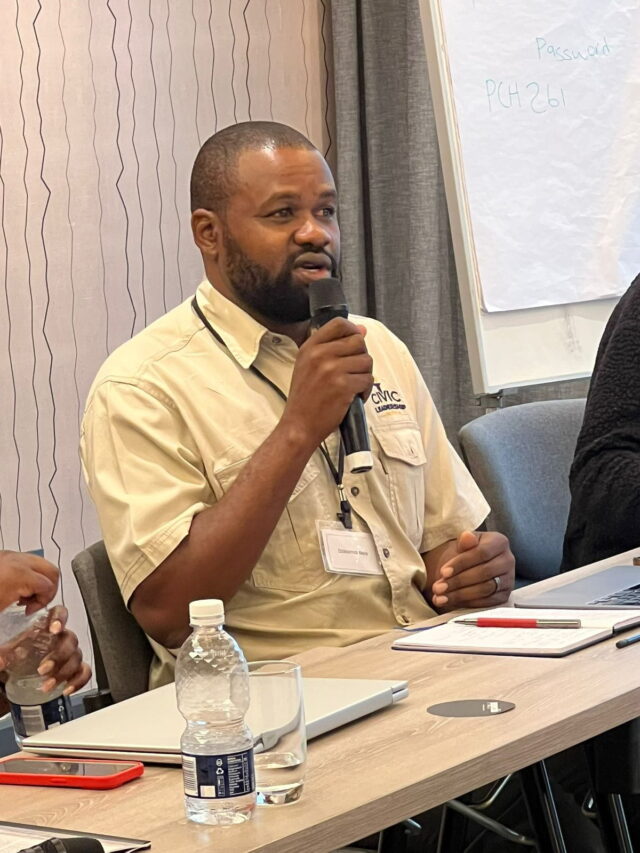
CLI Founder and Chief Executive Officer Dzikamai Bere reflected on Zimbabwe’s long transitional justice journey, from colonial violence and the liberation war to Gukurahundi, food riots, Operation Murambatsvina, farm displacements, the 2017 military coup, the 1 August 2018 killings, and continuing abductions. Attempts at redress have included commissions, accords, independent bodies, church interventions, civil society initiatives, memorialisation, music, film, and scattered community efforts.
Yet his assessment was stark.
“The transitional justice movement in Zimbabwe is at its weakest since 1980,” he said.
For Bere, this weakness reflects not only the failure of the state, but the condition of civil society itself. Transitional justice movements do not exist in isolation. They live inside broader civic ecosystems. When civil society is exhausted, fragmented, under-resourced, and under pressure, transitional justice weakens with it.
His central proposition was clear:
“The crisis of transitional justice in Zimbabwe is the same crisis in Southern Africa, and in many parts of the continent. What we call political will is actually a leadership issue.”
This was not a denial of state responsibility. It was a call to examine how political will is created, pressured, demanded, and sustained.
“We often say that states lack political will,” Bere said. “That may be true. But political will is a political fiction. There is no political will. There is only political accountability.”
The Constituency That Carries the Journey
Across the symposium, the role of civil society, survivor movements, community leadership, independent institutions, and public pressure returned again and again. Where the state is unwilling, incapacitated, or implicated, who carries truth forward?
This is where Sooka’s observation became the thread holding the symposium together:
“The journey continues because there is a constituency to carry on.”
A commission may close. A report may be tabled. A recommendation may be ignored. A prosecution may be delayed. A reparations programme may be weakened. But when a constituency remains organised, memory does not disappear. Denial becomes harder to sustain. Impunity becomes more contested. The past remains present in public life until it is responsibly addressed.
That constituency includes survivors, families, civic organisations, lawyers, scholars, artists, journalists, churches, feminist organisers, youth movements, psychosocial practitioners, and community leaders. It operates in courts, archives, villages, universities, digital platforms, streets, and public institutions. Its work is to keep truth alive when official mechanisms fall silent.
But this constituency must itself be sustained.
Bere named a reality many in the room recognised:
“We speak of victim fatigue. We speak of donor fatigue. Well, now we must speak of leadership fatigue.”
He described civic leaders facing state hostility, deep isolation, extreme exhaustion, executive loneliness, resource scarcity, and crises of ethical leadership. Many, he said, are trapped in constant firefighting. Some are no longer transitioning out of leadership, but fleeing from it.
This became one of the symposium’s quieter but most important insights. The work of truth recovery depends not only on commissions, laws, and recommendations. It also depends on the people and institutions that must carry the work over time. If those people collapse, the journey is at risk.
Truth Must Travel
By the end of the gathering, one lesson had become clear: truth must travel.
It cannot remain trapped in reports, court papers, archived testimony, or academic rooms. It must enter public memory. It must move through education, art, media, litigation, policy, organising, reparations, institutional reform, and everyday civic practice.
That responsibility now rests not only with those who built the first generation of truth recovery processes, but also with a new generation of transitional justice leaders who must carry the work into a more complex and uncertain world.
Reflecting on the symposium, Sesetu Holomisa of the Foundation for Human Rights, one of the TRC@30 programme hosts, captured both the weight and hope of the gathering.
“The space was filled with so much knowledge,” she said. “There were moments where I wished I could just endlessly listen to those who continue to work towards realising transitional justice in their communities. And there were times where everything felt bittersweet because the society imagined 30 years ago is not the reality we live in today.”
Her reflection carried the honesty of a new generation receiving an unfinished assignment. The symposium, she said, left her wondering: “What does it mean to dismantle systems of oppression, so meticulously embedded in every sphere of our lives?”
And yet, she did not leave the gathering in despair.
“I left feeling a bit hopeful,” she reflected. “The foundation laid by so many incredible human rights practitioners all over the world can only mean that there’s hope. For the present, for the future and for generations to come.”
That hope does not erase the unfinished work. It gives it direction.
Thirty years after the South African TRC, the work remains unfinished. But unfinished does not mean abandoned.
The journey continues.
And it continues because there is a constituency to carry on.
Report compiled by the Civic Leadership Institute.
