Excellence or Nothing: Mark Heywood on Why Social Movements Must Refuse Mediocrity
This Leadership Note is based on reflections shared by Mark Heywood during a leadership conversation with civic leaders. It has been prepared by the Civic Leadership Institute as part of its work to document, interpret, and share leadership insights emerging from the field.
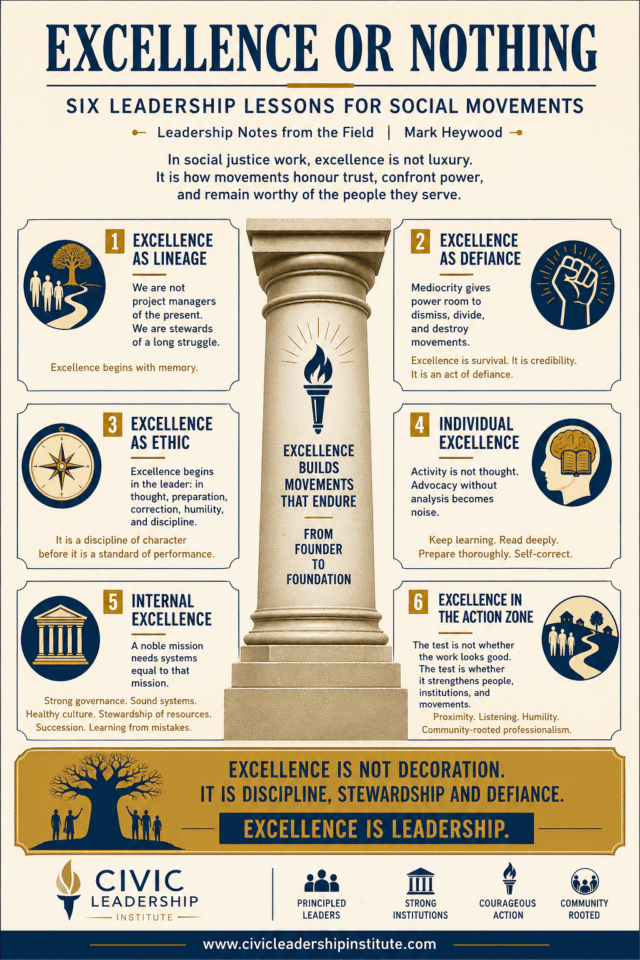
There are moments in the life of a social movement when excellence becomes more than an internal standard. It becomes a form of resistance.
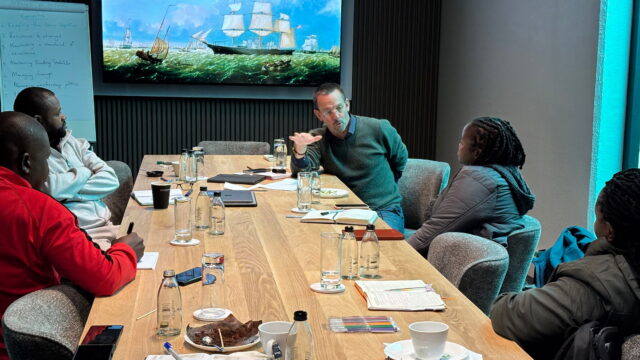
This was the central insight carried in Mark Heywood’s reflections on the place of excellence in social justice work. Speaking from more than four decades of experience in civil society, Heywood located the question of excellence within a long historical struggle for dignity, equality, justice, and morality. For him, civic leaders are not isolated actors responding to the crisis of the moment. They are part of a continuous global movement of people and organisations who have fought across generations for a better and fairer world.
That historical framing matters. Social justice work is often carried under the pressure of urgency. Leaders are forced to respond to immediate threats, shrinking resources, political hostility, institutional fatigue, and the daily burdens of communities in distress. In such conditions, it is easy to reduce excellence to a luxury, something to be pursued when there is enough time, money, staff, and stability.
Heywood offered a different view.
Excellence, in his framing, is not cosmetic. It is not perfectionism. It is not the polished language of professional organisations trying to impress funders. Excellence is political. Excellence is an act of defiance.
This insight speaks directly to the present condition of civic leadership across Africa. The civic sector is operating in a difficult moment. The rules-based order is under strain, resources are shrinking, authoritarian methods are adapting, and anti-rights narratives are becoming more organised. Civic leaders are confronting actors who are well-resourced, well-organised, and deeply serious about protecting privilege.
In such an environment, good intentions are not enough.
Being on the side of justice does not automatically produce victory. Moral clarity is essential, but moral clarity without discipline can become sentiment. Commitment without excellence can become noise. Courage without structure can become exhaustion. Movements that carry the aspirations of communities must therefore take seriously the quality of their work, the integrity of their systems, and the discipline of their leadership.
For the Civic Leadership Institute, this is where Heywood’s reflections meet the deeper task of institution building.
CLI was established around the conviction that civic leadership must move from firefighting to architecture. Firefighting is sometimes necessary. There are moments when leaders must respond quickly to repression, crisis, violence, legal threat, or institutional breakdown. But a sector that only fights fires will eventually lose the capacity to build. The work of justice requires more than reaction. It requires systems, memory, ethical formation, strategic clarity, operational discipline, and communities of accompaniment that allow leaders and institutions to endure.
Excellence is part of that architecture.
Excellence as Lineage
Heywood began by reminding civic leaders that they stand within a proud lineage. The struggle for social justice did not begin with today’s organisations, today’s funding cycles, or today’s campaigns. It stretches across centuries: the struggle against slavery, the struggle for women’s rights, the struggle against colonialism, and the continuing struggles for dignity, equality, justice, and morality.
This historical consciousness is essential for civic leadership.
When leaders forget their lineage, they shrink their assignment. They begin to see themselves as project managers rather than stewards of a long struggle. They reduce movements to activities, strategy to donor compliance, and institutions to instruments for surviving the next reporting period.
But when leaders remember their lineage, they recover depth. They understand that their work is part of a relay. Others carried the struggle before them. Others will carry it after them. Their task is not simply to perform in the present, but to strengthen the institutions, values, and practices that will make the struggle possible for future generations.
Excellence begins here: with memory.
A movement that forgets its history loses the moral seriousness required to sustain its future. It may still produce programmes. It may still convene workshops. It may still issue statements. But without lineage, the work becomes thin. It loses the sense of inheritance and obligation that gives civic leadership its weight.
For CLI, this is why the preservation of civic leadership knowledge is not an administrative exercise. It is part of the work of movement continuity. The stories, lessons, failures, disciplines, and practices of leaders in the field must be documented, interpreted, and passed on. The future of civic leadership cannot be built on institutional amnesia.
Excellence as Defiance
One of Heywood’s strongest observations was that civic actors are up against people and systems that are well-resourced, well-organised, and serious about protecting privilege. Those who oppose rights, equality, accountability, and justice are not casual. They have money. They have media. They have courts. They have prisons. They have think tanks. They have governments. They have networks.
This is why mediocrity is dangerous.
Poor preparation, weak analysis, careless writing, disorganised meetings, weak governance, poor financial controls, and inconsistent follow-through are not small internal weaknesses. In hostile environments, they become strategic vulnerabilities. They give opponents room to dismiss the movement, discredit its leaders, divide its institutions, and weaken public trust.
For social movements, excellence is therefore not about respectability. It is about survival. It is about credibility. It is about building enough strength, discipline, and integrity to confront power without being easily destroyed by it.
This is especially important in civic environments where public trust is fragile. Communities are often asked to believe in institutions that speak in their name. Development partners are asked to entrust resources to organisations. Victims and survivors are asked to share painful experiences with movements promising solidarity. Young activists are asked to give their energy to causes whose outcomes may take years to materialise.
In all these relationships, excellence becomes a form of accountability.
To be excellent is to refuse to waste people’s trust. It is to refuse to handle public pain casually. It is to refuse to produce poor work simply because the work is underfunded. It is to refuse the idea that because civic leaders are not working for high wages, poor quality is acceptable.
The communities we serve deserve more than our passion. They deserve our best.
Excellence as an Ethic
Heywood’s reflections also resist a narrow technical definition of excellence. Excellence is not only about outputs. It is about attitude, discipline, and ethic.
It includes always doing one’s best. It includes self-correction. It includes acquiring new knowledge and skills to better understand the issues one is confronting. It includes resisting mental laziness. It includes striving to become better. It includes being guided by an ethic.
This is important because civic leadership can easily become performative. Leaders can learn the vocabulary of rights, justice, participation, and accountability without allowing those words to shape the quality of their own practice. Organisations can demand accountability from the state while tolerating weak accountability internally. Movements can speak about dignity while treating their own teams poorly. Institutions can call for excellence in public systems while allowing mediocrity in their own operations.
Heywood’s argument closes that gap.
Excellence must begin inside the leader. It must shape how one thinks, prepares, writes, reads, listens, follows through, and corrects mistakes. It must shape the way one treats colleagues, communities, allies, opponents, and institutions. It must become a discipline of character before it becomes a standard of performance.
This connects directly to CLI’s understanding of leadership accompaniment. Civic leaders do not only need technical training. They need spaces where their judgement, courage, ethics, resilience, and discipline are formed over time. The old workshop model can transfer skills, but it rarely forms the whole leader. The work of civic leadership requires sustained support in the real pressures of the Action Zone, where decisions have consequences and where leaders must act under uncertainty.
Excellence, therefore, does not happen in a day. It is sharpened daily. This is what John C. Maxwell calls the Law of Process: leadership develops daily, not in a day. Excellence is not magic. It is the disciplined accumulation of thought, practice, correction, humility, and repetition over time.
Individual Excellence
At the individual level, excellence requires personal discipline.
It asks civic leaders to resist mental laziness. This is a strong and necessary phrase. The civic sector often operates under so much pressure that leaders can mistake activity for thought. They move from meeting to meeting, report to report, crisis to crisis, without taking time to read deeply, think carefully, prepare thoroughly, or test assumptions.
But leadership without thought becomes mechanical. Advocacy without analysis becomes noise. Action without reflection becomes repetition.
Individual excellence requires the leader to keep learning. It requires intellectual humility. It requires the courage to admit gaps in knowledge and the discipline to close them. It requires preparation before speaking, reading before writing, listening before prescribing, and reflection before action.
This is not academic luxury. It is movement discipline.
A leader who does not study the terrain will misread the struggle. A leader who does not sharpen their craft will weaken the institution. A leader who does not self-correct will eventually become a danger to the people they claim to serve.
Individual excellence also requires moral seriousness. The civic leader is entrusted with public interest. That trust must be carried carefully. The leader’s personal habits, choices, and standards affect more than their own reputation. They affect the credibility of the institution and, at times, the legitimacy of the movement itself.
Internal Excellence
Heywood also located excellence inside the organisation. He invited leaders to ask how they build organisations, what kind of organisational culture they cultivate, and how they lead.
This is where excellence becomes institutional.
An organisation committed to justice must examine the quality of its own internal life. How are decisions made? How are resources managed? How are staff treated? How are conflicts resolved? How does the board exercise oversight? How does the institution learn from mistakes? How does it prepare successors? How does it protect its mission from personalisation?
Many civic institutions are weakened not only by external repression, but by internal incoherence. Weak boards, unclear systems, poor supervision, founder dependence, financial fragility, unmanaged conflict, and lack of succession planning can hollow out an organisation from within.
This is why CLI understands institution building as central to civic renewal. A movement cannot be stronger than the institutions carrying it. A campaign cannot remain credible if the organisation behind it is collapsing. A leader cannot speak convincingly about accountability while presiding over systems that are opaque, personalised, or fragile.
Internal excellence is the discipline of building organisations that can carry responsibility.
It is not enough for an institution to have a noble mission. It must have systems equal to that mission. It must have governance structures that protect integrity. It must have financial systems that inspire trust. It must have leadership practices that multiply capacity rather than concentrate power. It must have a culture that honours both performance and care.
In this sense, excellence is not a department. It is the operating system of the institution.
External Excellence
Heywood identified another dimension: external excellence. This includes perception of integrity, quality, bravery, ideas, ingenuity, persuasion, and the discipline of never taking anyone for granted.
External excellence is about how a movement shows up in the world.
Civic work depends on public trust. It depends on the ability to persuade. It depends on the perception that the institution is serious, principled, prepared, and worthy of confidence. This does not mean image without substance. It means ensuring that the substance of the work is visible, coherent, credible, and compelling.
Movements must be brave. But bravery alone is not enough. They must also be persuasive. They must be able to translate complex issues into language people can understand. They must demonstrate ideas and ingenuity. They must treat communities not as passive beneficiaries, but as citizens with agency, wisdom, and leadership.
To never take anyone for granted is a profound civic discipline.
It means not taking communities for granted because they are poor. It means not taking staff for granted because they are committed. It means not taking volunteers for granted because they are passionate. It means not taking development partners for granted because they have funded the work before. It means not taking the public for granted because one assumes the moral cause is obvious.
The work of justice must keep earning trust.
Excellence as a Collective Value
Perhaps the most important contribution in Heywood’s reflections is the insistence that excellence is both individual and collective.
This matters because civic leadership is often personalised. Movements celebrate heroic individuals. Organisations become dependent on charismatic leaders. Public attention gravitates toward the visible face of the struggle. But social justice work is never sustained by one person alone.
Excellence must become collective. It must be shared across the team, the board, the membership, the volunteers, the communities, and the wider ecosystem of partners. If only one leader carries the standard, the institution remains fragile. If excellence is embedded in the culture, the institution becomes stronger than any individual.
This is the movement from founder to foundation.
A founder may inspire excellence. A director may model it. A board may demand it. But unless excellence becomes institutional culture, it will disappear when the visible leader leaves. The true test of leadership is not whether excellence is present while the leader is watching. The true test is whether excellence continues when the leader is absent.
This is also where accompaniment becomes essential. Leaders need communities that help them sustain standards under pressure. Teams need cultures that support correction without humiliation. Boards need the courage to demand quality without crushing initiative. Movements need elders and peers who can remind them of the standard when fatigue, fear, or scarcity begins to lower ambition.
No leader builds excellence alone.
Excellence in the Action Zone
For CLI, the question of excellence must finally return to the Action Zone.
The Action Zone is where civic leadership meets real life. It is where communities confront public power. It is where rights are defended, services are demanded, abuses are challenged, and institutions are tested. It may be in the street, the court, the village meeting, the boardroom, the policy table, the school, the marketplace, or the community hall. What matters is not the location, but the connection to the people whose lives are at stake.
Excellence in the Action Zone requires more than professional polish. It requires proximity. It requires listening. It requires courage. It requires humility before community wisdom. It requires the ability to translate analysis into action and action into institutional learning.
A beautifully written strategy that never reaches the community is not excellence. A campaign that impresses donors but fails to build local power is not excellence. A leader with international visibility but no connection to the base is not excellence.
Excellence must be measured by faithfulness to the mission and usefulness to the people.
This does not mean rejecting professionalism. It means rooting professionalism in community. CLI’s own doctrine of community-rooted professionalism insists that standards must be defined by values and impact, not only by academic degrees, donor language, or institutional polish. The question is not simply whether the work looks good. The question is whether it strengthens the people, institutions, and movements it claims to serve.
Activism as Privilege
Heywood closed his reflections by reminding civic leaders not to think of activism only as a burden. It is also a privilege. A rare opportunity.
This is a necessary word for a sector battling fatigue and leadership exhaustion.
Civic work is difficult. It carries risk. It demands sacrifice. It can wound the leader, strain families, and expose institutions to hostility. But it is also a privilege to stand in the long line of those who have refused injustice. It is a privilege to serve communities. It is a privilege to build institutions that can protect dignity. It is a privilege to contribute, however modestly, to the unfinished work of freedom.
When activism is seen only as burden, fatigue becomes the dominant story. When it is also seen as privilege, responsibility is renewed.
This does not romanticise suffering. It does not deny the need for care, rest, fair compensation, and institutional support. Rather, it places the burden within a larger horizon of meaning. The work is hard because it matters. The standard must be high because people depend on it. The discipline must be serious because the struggle is serious.
Excellence is how civic leaders honour that privilege.
The CLI Reflection
Mark Heywood’s reflections offer a timely challenge to civic leaders and institutions across Africa.
At a time when many organisations are under pressure to survive, he reminds the sector that survival without excellence is not enough. At a time when resources are shrinking, he reminds us that scarcity cannot become an excuse for poor quality. At a time when movements face organised resistance from powerful interests, he reminds us that anything less than excellence will not succeed.
For CLI, this message sits at the heart of the move from firefighting to architecture.
The next phase of civic leadership in Africa will require institutions that are principled, disciplined, rooted, courageous, and well-built. It will require leaders who are formed, accompanied, and accountable. It will require movements that treat excellence not as a performance for funders, but as a responsibility to communities.
Excellence is not decoration. It is discipline, stewardship and defiance. Excellence is leadership.
And in the long struggle for justice, it may be one of the ways movements remain worthy of the people they serve.
Civic Leadership Institute
Serving those who serve our communities.
